
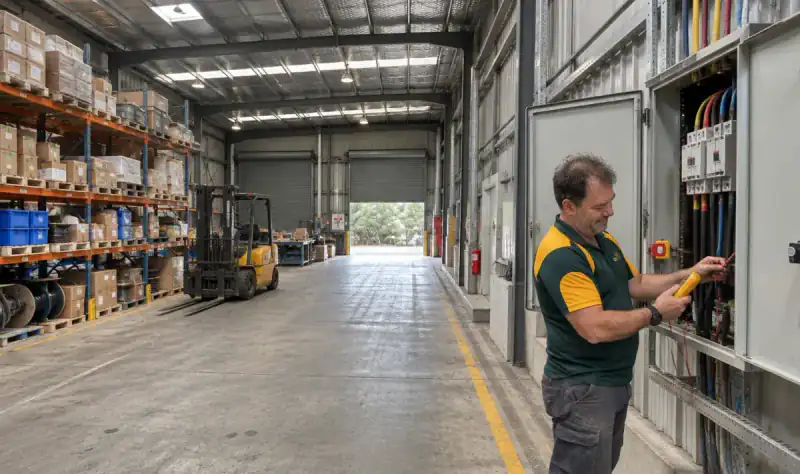
A fit-out runs on trades arriving in the right order. The electrician sits near the front of that order, because cabling goes in before walls and ceilings close. Get it wrong and someone is cutting open new plasterboard.
Ozelect is a Moss Vale electrical contractor. It works on shops, cafes and offices across the Southern Highlands, and this page sets out what an electrician for a commercial fit-out covers, how the work fits around the builder, and what you should have in hand at handover.
What a commercial fit-out electrician covers in the Southern Highlands
The electrical scope of a fit-out is the full set of services a tenancy needs to trade safely: power, light, data and protection. It usually covers:
- power points and dedicated circuits for equipment
- lighting, including controls and switching
- data outlets and cabling
- safety switches on each circuit
- emergency lighting and exit signs
- any switchboard changes needed to carry the new load
Switchboard changes matter more than people expect. A tenancy that was a quiet office last year may now be a cafe with a coffee machine, a dishwasher and refrigeration, and the old board may not cope.
The electrician’s work stops where the building trades start. Walls, ceilings, joinery, counters and finishes belong to the builder or shopfitter, and the electrician works to their drawings and program. The electrician does not move a wall to suit a power point, and the builder does not run circuits to suit a counter.
Data cabling and emergency lighting are scoped job by job. The written quote states what is included, so you know before work starts who is doing what.
Ozelect’s commercial and industrial electrical services cover this work alongside larger commercial and industrial jobs.
Electrical scope for cafe, shop and office fit-outs
Every fit-out starts from the same base: a floor plan, a lighting and power layout, and a clear idea of what will plug in where. The detail then splits by business type.
A shop fit out electrician plans around the till point first. A retail shop usually needs till and EFTPOS power, display lighting on its own switching so windows and feature walls can be controlled separately, and signage circuits that run to the façade. Counters and shelving are often fixed early, so those positions need to be settled before the shopfitter starts. For retail electrical fit out work in NSW, Ozelect’s focus is the Southern Highlands: Moss Vale, Bowral, Mittagong and the towns around them.
Cafe electrical installation: kitchen and equipment circuits
Cafes carry the heaviest electrical load of the three. In a typical Moss Vale cafe fit-out, coffee machines, dishwashers, refrigeration and extraction usually need their own circuits, worked out with the shopfitter before linings go in.
Separate circuits mean one tripped appliance doesn’t take out the whole kitchen. They also keep a high-draw machine like a commercial coffee machine from sharing a cable with the lights over the counter.
Extraction needs attention early, because ducting and wiring have to be planned together. Refrigeration needs a circuit that stays reliable, since a fault overnight means lost stock.
Each circuit gets a safety switch. In a wet, busy kitchen that is the protection you want between staff and a faulty appliance.
Office electrical fit-out: data, lighting and power
An office is mostly about people and screens. An office electrical fit-out usually groups data outlets and power at desk clusters, with lighting zones for open-plan areas and separate zones for meeting rooms.
Desk layout drives the whole plan. If the furniture plan changes after rough-in, outlets end up under the wrong desks, so you should lock the layout before cabling starts.
Zoning pays off after opening. A meeting room that can be dimmed or switched on its own saves running the whole floor’s lighting for one booking.
Plan for growth, too. A few spare outlets or a spare way in the switchboard costs little during a fit-out and a lot more once the carpet is down.
Commercial lighting installation and power layouts
Commercial lighting installation in Moss Vale starts on paper, well before anyone climbs a ladder. The electrician reads the ceiling plan and the layout, then works out where each fitting, switch and power point goes.
Four things get planned together:
- Power point positions, set against counters, benches and desks.
- Lighting zones, so areas can be switched separately.
- Controls, including dimming, zoning and sensors.
- Emergency lighting, placed so exits and escape paths are covered.
This all happens before the shopfitter fixes counters and joinery. Once a counter is fixed, moving a power point behind it means pulling things apart, and that costs time and money.
Ceiling type changes the work. A suspended grid ceiling, plasterboard and an open ceiling with exposed services each call for different fittings and different cable routes.
Controls need a decision early rather than a late upgrade. Sensors and dimming work best when the wiring is run for them at rough-in, and adding them after linings are on is slower and messier.
A lighting layout can only be as good as the plans it’s drawn from. If the tenancy plan is still moving, the lighting plan will move with it, and the quote may need to be revisited.
Working with builders and shopfitters
On most fit-outs the builder or shopfitter runs the job, and the electrician fits around them. That arrangement works well when the electrician has drawings and milestone dates early, and badly when the first call comes the week linings go up.
Rough-in before linings, fit-off after
The electrical work comes in two visits, and each has its own timing.
Rough-in comes first. It covers cabling and back boxes, and it goes in before walls and ceilings close. After that, the builder can line the walls.
Fit-off comes later, once joinery and finishes are in. It covers power points, switches, light fittings, final connections and testing. An electrician can’t fit off a switch plate onto a wall that isn’t painted, and can’t test a circuit until the equipment on it is in place.
The gap between those two visits is where programs slip. If joinery arrives late, fit-off waits, and the opening date waits with it.
Who holds the program and approves variations
The builder or shopfitter usually holds the program. The electrician needs the milestone dates and the current drawings, so the rough-in booking lands before the linings, not after.
Site access and isolations are agreed up front. If a circuit has to be turned off in an occupied building, everyone on site needs to know when and for how long.
Variations get agreed in writing before the work changes. A moved counter or an extra outlet is a small change on site and a real cost on paper, so it helps to have the price and the approval on the record.
Scheduling electrical work to keep downtime short
Downtime is the cost a business owner notices most. Every day a cafe or shop stays closed is a day without takings, so the electrical schedule is built backwards from the opening date.
Ozelect ties its work to the builder’s milestones and to the sign-off date. The aim is for rough-in, fit-off and testing to land in the right order, without leaving gaps where nothing is happening.
Large jobs are staged by area. The front of a shop can be finished and tested while the back room is still being built, which stops everything bunching up at the end.
The honest limit is that scheduling can shorten downtime but can’t remove it. If the builder’s program slips, or the board needs a bigger upgrade than expected, the dates move.
Staging work around trading hours
When a business is open during the work, the job has to be planned around its customers. Early starts and after-hours work are the usual options, and you should raise them when you ask for a quote so they’re priced in from the start.
Switchboard changes are the clearest case. They are typically booked for an agreed window outside trading hours, with the isolation plan confirmed with the builder beforehand, so the premises can reopen on the agreed day.
A typical Southern Highlands cafe fitting a new board might lose power for a short, planned window after closing. The coffee machine is back on for the morning, and nobody lost a trading day.
Compliance, certificates and sign-off
Electrical work in NSW must be done by licensed people. If you want to check a contractor before engaging them, Ozelect’s guide to choosing a licensed electrician in NSW covers what to look for.
Handover is where the paperwork becomes your problem, because you hold the records after the trades leave. This is what a client should expect to receive, and none of it is optional extras.
Certificate of Compliance and handover testing
Electrical work in NSW generally needs a Certificate of Compliance, issued by the licensed person or contractor responsible for the work and provided to the client. NSW Fair Trading sets out the current requirements for electrical work and what must be lodged, and it is worth checking there for the latest steps.
Before the certificate is issued, the electrician tests the work. That includes safety switches, emergency lighting and exit signs, along with the circuits on the new fit-out.
A test is only meaningful once the equipment is in. That is why testing sits at the end of fit-off, not the start.
Handover records and circuit labelling
Each circuit should be labelled at the switchboard, and the switchboard records updated to match. A new tenant, a maintenance electrician or an insurer can then see what each circuit feeds without opening walls.
The builder or building certifier needs the electrical sign-off before the business opens. If the paperwork isn’t ready, the opening date is at risk, however finished the shopfront looks.
Keep the certificate and test records with your lease or property file. They are the proof the work was done by a licensed person and tested.
How to get a commercial electrician quote in Moss Vale
Ozelect is a commercial electrician in Moss Vale and works across the Southern Highlands. The usual steps are simple: plans and program come in, Ozelect makes a site visit where the job needs one, and a written quote goes back out.
The site visit matters most on older premises. Existing switchboards, cable routes and ceiling spaces are hard to judge from a drawing.
A written quote should spell out:
- what’s included, room by room or circuit by circuit
- what’s excluded, so there are no surprises later
- testing and sign-off
- how variations are priced
If a quote is a single line with a total at the bottom, you can’t compare it with anyone else’s. You should ask for the breakdown.
If you are still weighing up options, the guide to hiring a local electrician in the Southern Highlands covers what separates a reliable local from a quick quote.
What to send for an accurate quote
An accurate quote starts with four things:
- The floor plan.
- The lighting and power layout.
- The builder’s program, with milestone dates.
- Any equipment lists, such as cafe appliances or office desk counts.
Without the program, the quote can’t account for rough-in timing. Without the layout, power and lighting are estimates, and estimates move.
You don’t need perfect drawings to start. Send what you have, and Ozelect will say what is missing.
When you’re ready, send your plans for a written quote. Ozelect will review the scope for your shop, cafe or office and reply in writing. For the wider range of local work, see the Moss Vale electrician services page.
Frequently asked questions
Do I need a Certificate of Compliance for a shop or cafe fit-out?
Electrical work in NSW generally needs a Certificate of Compliance, issued by the licensed person or contractor who did the work and given to the client. Keep it with your lease or property records. NSW Fair Trading publishes the current requirements, so check there for the latest steps.
How early should the electrician be involved in a fit-out?
Before the walls and ceilings are lined. Rough-in cabling and back boxes have to go in first, so the electrician needs the builder’s or shopfitter’s program and the current drawings early. If the call comes after linings are up, the work gets slower and costs more.
What does a commercial fit-out quote need to include?
A written quote should state what is included, what is excluded, testing, sign-off and how variations are priced. To get one, send the floor plan, the lighting and power layout and the builder’s program. Without those, the quote is an estimate that is likely to change.
Can switchboard changes be done without closing the business for days?
Often, yes. Switchboard work is typically booked for an agreed window outside trading hours, with the isolation plan confirmed with the builder beforehand. The premises can then reopen on the agreed day, though a larger upgrade or a slipped program can still change the timing.
Does Ozelect work outside Moss Vale?
Yes. Ozelect is based in Moss Vale and works across the Southern Highlands, including Bowral and Mittagong. Send the address with your plans through the contact page and Ozelect will confirm the job.