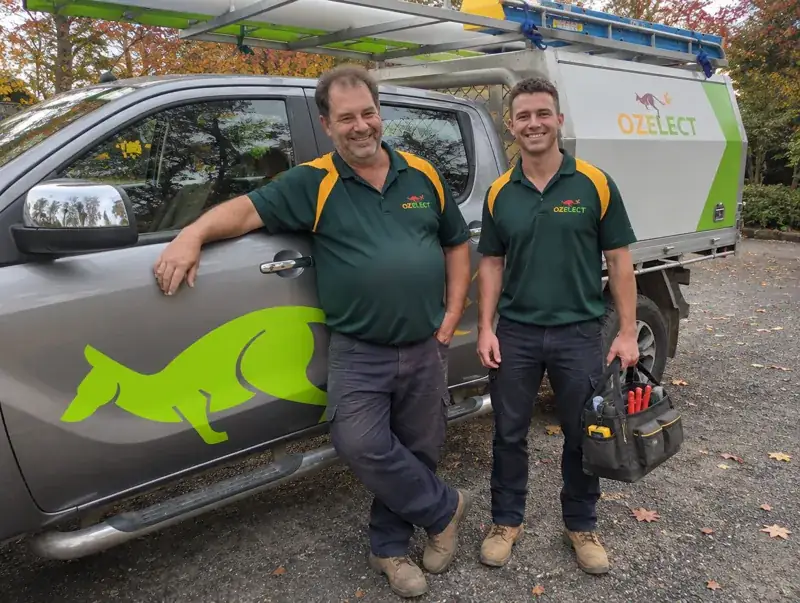
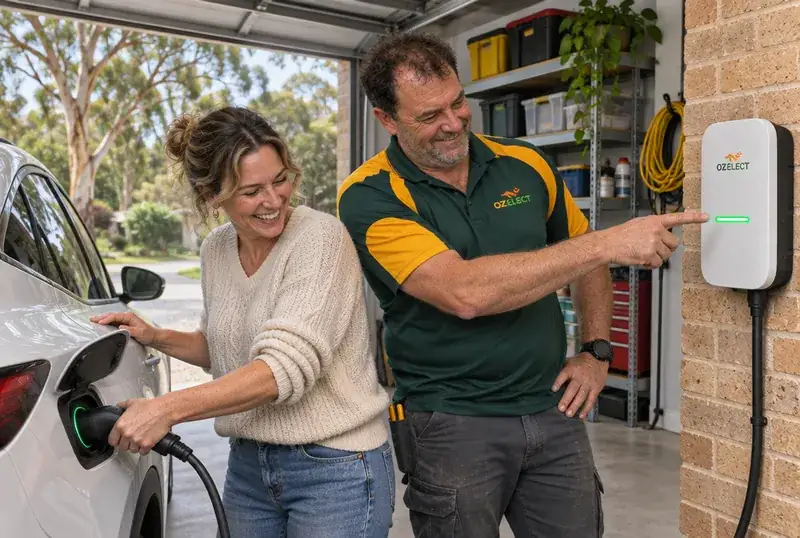
Fitting a charger is the easy part. What decides the job is the house, the switchboard and the supply behind them. In the Southern Highlands, those three vary a lot from one property to the next.
This guide covers what an installer checks, what shifts the price and what the process looks like. Ozelect wrote it from the Moss Vale side of the job.
What makes EV charger installation in the Southern Highlands different
Many Highlands homes are older. Some have original or partly updated switchboards, and plenty of properties sit on acreage with sheds, workshops and garages well away from the house.
That changes the work. A wall charger draws a lot of power for hours at a time, so the board, the supply and the cable route all have to cope. The charger brand matters far less than any of those.
Ozelect is a Moss Vale electrical contractor working across the Southern Highlands, so the local checks in this guide reflect work in the region. If you want a licensed Moss Vale electrician to look at your property, the checks below are what that visit should cover.
A home EV charger installer should tell you what the site needs before talking about the charger itself.
Single-phase or three-phase supply: check it before choosing a charger
Most homes run on single-phase supply. Some larger homes, rural properties and commercial sites have three-phase. Which one you have sets the ceiling on how fast any charger can work, so it needs settling before you buy a charger.
How to confirm which supply your home has
An electrician confirms the phase count by looking at the meter, the main switch and the service cable coming into the property. A bill or a guess is not a reliable way to tell, because the bill describes your tariff and not the wiring.
Don’t open the meter box or the switchboard to check for yourself. The electrician reads the supply from the outside of the equipment and tests it where needed.
If you’re not sure, ask for the check at the site visit. It takes little time, and it saves you from buying the wrong hardware.
Three-phase EV charger at home: what actually changes
A three-phase charger on a single-phase home still charges at the single-phase rate. For example, a home on a single-phase supply is fitted with a charger that can also run on three-phase. It still charges at the single-phase rate.
Getting three-phase charging means the supply itself has to change. That usually involves the network operator and adds time, along with extra works at the meter and board. If you’re curious how the two systems differ in principle, Wikipedia’s page on three-phase power covers it.
Three-phase is not always worth chasing. A single-phase charger often covers a household’s overnight needs, and a supply upgrade only makes sense when the driving pattern or the property demands it.
Switchboard capacity checks and upgrades
The switchboard is where most home charger jobs are won or lost. A charger needs its own circuit, its own protection and enough headroom on the main switch, and many older boards can’t offer all three without work.
Capacity checks: spare space, main switch and existing load
An installer works through the same questions on every board:
- Is there spare breaker space for a new circuit?
- What is the main switch rated for?
- What heavy loads already run, such as electric hot water, an electric cooktop or oven, air conditioning and workshop equipment?
- Does the board have RCD protection?
The existing load matters because a charger runs for hours. A home that already pulls a lot at night, with hot water heating and a cooktop going, leaves less room than the main switch rating suggests.
Load management can help here. A charger with load management reads what the house is drawing and lowers its own output to stay within the supply. It works well when the board is sound and the supply is only tight at certain times.
It is not a fix for a board that is unsafe, full or undersized. If the supply can’t carry the charger even at a reduced rate, or the reduced rate is too slow for how you drive, a supply or board upgrade is the real answer.
When an EV charger switchboard upgrade is needed
Board work usually comes first when the board has rewirable fuses, no RCD protection or no spare space. For example, an older Southern Highlands home may have a switchboard with rewirable fuses, no RCD protection or no spare breaker space. A charger circuit can’t simply be added to a board like that, so the quote should include the board work before the charger goes in.
Age raises a second issue. For example, a board from an earlier era may contain asbestos-based backing or parts. The safe approach is an assessment before anyone opens or alters it, and a homeowner should never open the enclosure to check it.
An upgrade isn’t automatic, though. A modern board with spare space and RCD protection often takes a charger circuit without any board work at all.
Rural and acreage properties: long cable runs, earthing and outbuildings
Acreage changes the job in ways a suburban install never meets. Distance, ground conditions and the age of the existing wiring all feed into the quote. Ask for these checks early, because they’re hard to price from a phone call.
Distance from the switchboard drives cable size. The longer the run, the larger the cable needed to keep voltage drop in check, and larger cable costs more and needs more room to run.
Then there’s the route. Cable between buildings may need trenching or conduit, depending on the ground and what sits in the way.
Earthing needs a look on rural properties. Where the property runs on tank water, earthing may rely on an earth electrode instead of a metal water pipe. That has to be confirmed on site, since it affects how the new circuit is protected.
Bushfire-prone land mapping is another early check. Much of the region falls under it, and it’s better to know before the quote is firm than after.
Cable runs to sheds, workshops and detached garages
A charger in an outbuilding often needs a sub-board there, with its own protection, fed from the main board by a dedicated cable. For example, a charger wanted in a machine shed at the far end of an acreage block means a longer cable run, possibly trenching or conduit, and an earthing check at the shed. Those items can move the quote more than the charger does.
If you can mount the charger on the house or an attached garage, the run shrinks and so does the cost. The convenient spot for parking isn’t always the sensible spot for the cable.
Installation steps and timing, from site visit to handover
The sequence is the same on most jobs, even though the details differ.
- Site assessment: the installer checks the supply, board, charger location and cable route.
- Itemised quote: the work is broken into parts so you can see what drives the price.
- Approvals, where needed.
- Circuit run and protection.
- Charger mounting.
- Testing.
- Certificate of compliance.
- Handover, with the charger’s settings explained.
Timing is usually set by network approvals, trenching and board works, not the charger. A simple install on a sound board can be quick. A job that needs a supply change or a long trench takes longer, and the approvals sit outside the electrician’s control.
For that reason, Ozelect doesn’t promise a fixed timeline before seeing the site. A range of outcomes is the honest answer until the assessment is done.
What a wall charger electrician does on site
On the day, the electrician runs the dedicated circuit from the board, fits the right protection and mounts the charger on a suitable wall or post. The circuit is then tested before anything is switched on for use.
The job ends with a certificate of compliance and a walk-through. You should leave knowing how to use the charger, what the settings do and how to adjust any load management.
Approvals and compliance for electric car charger installs in NSW
In NSW, charger wiring must be done by a licensed electrician, and the electrician provides a certificate of compliance when the work is finished. That is not optional, and a charger installed without it can cause trouble with insurers and at sale time. If you’re comparing installers, how to choose a licensed electrician in NSW explains what to check.
Other approvals depend on the property:
- Network operator approval: can apply when the supply changes, such as a move to three-phase, or when the new load needs the network’s sign-off.
- Owners corporation consent: applies in apartments and townhouses where parking or supply sits on common property. For that kind of site, see strata property electrical work in Moss Vale.
- Heritage rules: can limit where a charger or cable goes on a heritage-listed home.
Council approval is rarely the issue for a standard install. A wall charger on a house or garage usually doesn’t need it, though a site with unusual works such as major trenching or a new structure is worth checking.
What an installed EV charger costs and how to get a quote
The installed price turns on the site. Two homes with the same charger can land far apart, because the switchboard works, cable run and any supply upgrade can move the total more than the charger does.
For that reason, this guide doesn’t put a figure on EV charger cost installed. A number given without seeing the board and the cable route would be a guess, and Ozelect would rather quote from the site.
Cost drivers that move the installed price
These are the items that move the price most:
- Switchboard works, including a new board or added protection.
- The length of the cable run from board to charger.
- Trenching or conduit between buildings.
- A sub-board for a shed or detached garage.
- A supply upgrade, such as a move to three-phase.
- The charger itself, which is usually the smaller part of the total.
A straightforward job on a sound board, with the charger close by, sits at the lower end. A long run to an outbuilding on an older board sits at the other.
What a Moss Vale installer needs for an accurate quote
Send these details with your enquiry:
- Property type: house, acreage, townhouse or apartment.
- Where you want the charger and roughly how far that is from the switchboard.
- Outside photos of the switchboard and its label, taken without opening anything.
- Your supply type, if you know it.
- Any solar or battery system.
- Site access, including gates, locked areas and parking position.
With those in hand, the quote is closer to the real figure. Anything unclear gets confirmed at the site visit, which is when the quote becomes firm. The Southern Highlands electrician guide is useful if you’re still comparing local options.
Ready to go ahead? Book a site visit and quote with Ozelect’s Moss Vale team through the contact page.
Frequently asked questions
Can I put a three-phase EV charger on a single-phase home?
You can fit one, but it will charge at the single-phase rate. Faster three-phase charging needs the supply itself to change, which usually involves the network operator and extra works. Confirm your supply type before choosing a charger.
Will my old switchboard need replacing before a charger goes in?
Not always. Rewirable fuses, no RCD protection or no spare breaker space usually mean board work comes first. A sound modern board with spare space can often take a charger circuit as it stands. An electrician confirms this with a capacity check on site.
Can I open my switchboard to check what’s in it?
No. Older boards can contain asbestos-based parts, so nobody should open or alter one without an assessment. Take photos of the outside of the board and its label, and leave the rest to the electrician.
Do I need council approval to install a home EV charger in NSW?
Council approval is rarely the issue for a standard install. What does apply is licensed electrician work with a certificate of compliance. Depending on the property, you may also need owners corporation consent, heritage clearance or network operator approval.
Why can a shed install cost more than one on the house wall?
A shed means a longer cable run, which needs larger cable to limit voltage drop. It may also need trenching or conduit, a sub-board and an earthing check at the shed. Those items can add more to the quote than the charger does.